Why you can't be random
Ask someone to pick zones at random and the result comes out too tidy: too many switches and too few repeats. That tidiness is a pattern, and patterns get read.
What random really looks like
Here are two series of five kicks (L = left, M = middle, R = right). Which one looks random?
| Series | Five kicks |
|---|---|
| A | L R M L R |
| B | R R L R M |
Most people pick A: every zone used, no repeats, nicely balanced. But a fair die rarely produces anything that neat:
- About 80% of truly random five-kick series contain a back-to-back repeat, like the RR that opens B. Series with no repeat at all, like A, turn up one time in five.
- In about 63% of series one zone comes up three times or more, as R does in B.
- Over ten kicks, more than half of random series contain the same zone three times in a row.
Real randomness is lumpy. Human randomness is smooth, and that gives people away.
What the research found
Too many switches, runs too short
Willem Wagenaar's 1972 review of experiments in which people wrote out random sequences found what later work keeps confirming: people switch too often. Their sequences contain too many alternations and too few repeats, so runs of the same choice come out too short. Amnon Rapoport and David Budescu (1997) modelled the process and tested it in three experiments with two or three equally likely options. The sequences over-alternated, and their counts stayed closer to an even split than chance would allow.
Better when it matters, but not enough
Maybe people fail only because the task is dull? Rapoport and Budescu (1992) had people play matching pennies in the lab, where being unpredictable is the whole point. Their sequences came out closer to random than when people were simply asked to produce a random series. A follow-up (Budescu & Rapoport, 1994) still found departures from randomness in both kinds of task: a real opponent helps, but it does not turn anyone into a fair coin.
Win-stay, lose-shift
Zhijian Wang, Bin Xu and Hai-Jun Zhou (2014) had 360 students play rock-paper-scissors in groups of six, 300 rounds per group. Each move was played close to a third of the time, as equilibrium predicts, yet one move was linked to the next. A player who had just won was more likely to repeat that move than to switch to either of the other two. After a loss, in most of the payoff settings tested, the likeliest next move was the one that beats whatever had just won. The counts looked perfect; the order gave players away.
Keepers fall for it too
Erman Misirlisoy and Patrick Haggard (2014) studied all 361 kicks from 37 penalty shootouts at major international tournaments between 1976 and 2012. Each shooting team's sequence looked close to random. The keepers' did not: after shooters had gone the same way several times running, keepers became more and more likely to dive the other way. That is the gambler's fallacy: a streak feels "due" to end. The shooters did not exploit it.
Spotting a pattern is hard as well
Erik Brockbank and Edward Vul (2021) had fixed pairs play 300 rounds of rock-paper-scissors. People's own moves carried surprisingly complex links to what had come before, yet players failed to exploit links like these in the person opposite. That is why every career rival has one clear weakness rather than a puzzle. A computer, though, will notice.
How the computer reads you
Penalty Bluff's computer opponents borrow an idea from the First International RoShamBo Programming Competition, a 1999 rock-paper-scissors contest for computer programs. The winner, Dan Egnor's Iocaine Powder, ran several ways of predicting its opponent side by side, with a layer on top checking which was working best. Penalty Bluff does the same, with small predictors that each have one idea about you:
- Frequency: which zones you pick most, in this match and across matches.
- Sequences: what you tend to do after your last one or two picks.
- Win-stay, lose-shift: whether you repeat after a success and move after a failure.
- Streak breaking: whether you switch after two picks the same way.
- Cross-role: whether you dive where you last shot.
- Reactions: whether you copy the computer's picks or steer away from them.
Each predictor votes on your next pick, weighted by how well it has predicted you so far. The votes are multiplied, so several small habits add up to a confident read. As keeper, the computer dives where your shot is most likely to go. As shooter, it aims where your dive is least likely. The reading levels also pick at random on some kicks.
Rookie has a fixed habit of its own and learns nothing. Amateur counts how often you pick each zone and what you do right after a pick. Pro adds win-stay, lose-shift, streak breaking and longer sequences, and remembers your last 60 picks in each role. Legend uses every predictor and remembers up to 200 picks per role from your earlier matches, stored on your device.
None of this involves peeking. The computer seals its pick at the start of the kick and never sees yours. Against a truly random player in Classic it saves one kick in three on average, whatever the level. Every save above that comes from your patterns.
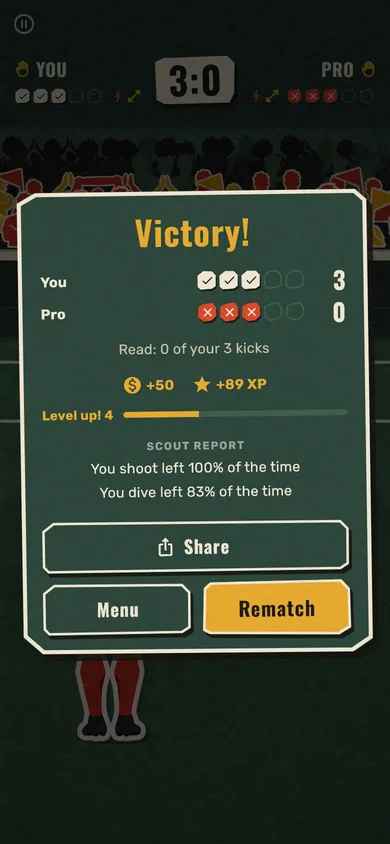
After a match against the computer or online, the final card can show a scout report with your strongest habit in each role, once the game has seen enough picks to say so.
Why switching every time is a pattern
The obvious fix, never doing the same thing twice, is exactly the bias the research describes. If you never pick the same zone twice in a row, a keeper can rule out your last zone and choose between the other two. In Classic that lifts the save rate from one in three to one in two; in Pro, from one in five to one in four. Strict left-right-left alternation is worse still: after two kicks, the keeper knows where nearly every shot is going.
The same goes for any rule: "after a goal, switch", "after two the same, go the other way", "go where I haven't been". A rule is a pattern. True randomness has no memory. Your last kick should tell nobody anything about your next one, including you.
How to fake a better coin
Your brain is a poor coin, so borrow a better one: take your zone from something outside your head, before you think about the score or your rival.
| Randomiser | Classic (3 zones) | Pro (5 zones) |
|---|---|---|
| A die | 1–2 left, 3–4 middle, 5–6 right | 1–5 is the zone; roll again on a 6 |
| Last digit of a clock's seconds | 0–2 left, 3–5 middle, 6–8 right; on a 9, look again | 0–1 zone 1, 2–3 zone 2, 4–5 zone 3, 6–7 zone 4, 8–9 zone 5 |
| A phrase you know by heart | One letter per kick: A–G left, H–O middle, P–Z right | Uneven in five; use a die or a clock |
- Glance, don't time it. If every kick takes the same time and you always look at the same moment, the digit moves in steady steps: a pattern again.
- For letters, use a line you didn't choose for the game, such as a song lyric, and carry on where you stopped. In ordinary English text each group covers roughly a third of the letters.
- Obey it when it feels wrong. The urge to overrule a third "left" in a row is the very bias you are trying to beat.
- Decide before the kick. You can even write a sequence for the whole match in advance.
Random is a shield, not a weapon. It holds your rival to one save in three, but it never beats anyone. Play random by default and break from it on purpose only when you have a read. How to read your rival and the game theory of a penalty kick explain when.
Sources
- Brockbank, E. & Vul, E. (2021). Formalizing opponent modeling with the rock, paper, scissors game. Games, 12(3), 70.
- Budescu, D. V. & Rapoport, A. (1994). Subjective randomization in one- and two-person games. Journal of Behavioral Decision Making, 7(4), 261–278.
- Egnor, D. (2000). Iocaine Powder. ICGA Journal, 23(1), 33–35.
- Misirlisoy, E. & Haggard, P. (2014). Asymmetric predictability and cognitive competition in football penalty shootouts. Current Biology, 24(16), 1918–1922.
- Rapoport, A. & Budescu, D. V. (1992). Generation of random series in two-person strictly competitive games. Journal of Experimental Psychology: General, 121(3), 352–363.
- Rapoport, A. & Budescu, D. V. (1997). Randomization in individual choice behavior. Psychological Review, 104(3), 603–617.
- Wagenaar, W. A. (1972). Generation of random sequences by human subjects: a critical survey of literature. Psychological Bulletin, 77(1), 65–72.
- Wang, Z., Xu, B. & Zhou, H.-J. (2014). Social cycling and conditional responses in the Rock-Paper-Scissors game. Scientific Reports, 4, 5830.
Now that you know what a pattern looks like, go and find one in somebody else.