The game theory of a penalty kick
A penalty is a guessing game between two people who both want to be unreadable. Economists have studied it with real match data, and their findings explain how Penalty Bluff works and how to win at it.
Matching pennies with a ball
Take away the run-up and the crowd and a penalty becomes one of the oldest games in game theory: matching pennies. Two players each show a coin. One wins if the coins match, the other if they don't. The keeper wants a match, the shooter a mismatch.
No fixed choice survives this. If the keeper always dives left, the shooter goes right; if the shooter always goes right, the keeper follows. Any known habit can be punished, so the only stable way to play is to mix: give each option a probability and choose kick by kick, with no pattern.
A set of odds like this is a mixed strategy, and a pair of them where neither player gains by changing is an equilibrium. John von Neumann's minimax theorem (1928) guarantees one exists in games where one side's gain is the other's loss. The idea is simple: pick your odds so that your opponent gets the same result whatever they do, and they have nothing to exploit.
Real penalties are lopsided
Real kicks are not symmetrical. Most players find it easier to strike towards their "natural side", which for a right-footed shooter is the left of the goal as seen from behind the ball. A study of 459 penalties in two top European leagues measured how often each kind of kick went in:
| Kick goes to… | Keeper guesses right | Keeper guesses wrong or stays |
|---|---|---|
| Shooter's natural side | 63.6% scored | 94.4% scored |
| The other side | 43.7% scored | 89.3% scored |
Put these numbers through the equilibrium sum, setting the middle aside, and the shooter should go to their natural side about 60% of the time and the keeper about 66%. The second figure surprises most people: the keeper should lean towards the shooter's strong side more than the shooter does. Each player's odds are set by the other player's numbers. The strong side scores better whether or not the keeper guesses it, so the keeper has to guard it more often until it is no better than the weak side.
What the studies found
Professionals mix roughly as predicted
Pierre-André Chiappori, Steven Levitt and Timothy Groseclose (2002) tested these predictions on the same 459 kicks. The data fitted shooter and keeper choosing at the same time, and a player's previous penalty did not predict their next. Setting the middle aside, shooters went to their natural side 54% of the time and keepers 58%. That is lower than our rough 60 and 66, but in the predicted order, with keepers leaning harder.
Ignacio Palacios-Huerta (2003) collected 1,417 penalties from professional European leagues between 1995 and 2000, enough to test 42 players one by one: 22 shooters and 20 keepers with at least 30 penalties each. Both predictions of the minimax theorem held. Each player's success rate was statistically the same whichever side they chose (about 80% of kicks scored either way), and each choice was independent of the ones before. The few players who failed a test were about as many as chance alone would produce.
The middle is a blind spot
The centre is the awkward part. Palacios-Huerta treated each kick as a two-way choice, so his test says little about it. In the 459-kick study, shooters went down the middle 79 times (17%), keepers stayed there only 11 times (2%), and central kicks scored most often of all, 81%. The authors note that pooled data should flatter central kicks, because the players who choose them tend to be good at them.
Michael Bar-Eli and colleagues (2007) asked the keeper's question directly. In 286 penalties from top leagues and championships around the world, shooters sent 28.7% of kicks to the middle third of the goal, but keepers stayed there only 6.3% of the time (left and right below are the keeper's):
| Keeper's action | Share of kicks | Kicks saved |
|---|---|---|
| Dived left | 49.3% | 14.2% |
| Stayed in the centre | 6.3% | 33.3% |
| Dived right | 44.4% | 12.6% |
Staying put saved kicks more than twice as often, yet keepers almost never did it. Only 18 kicks fall in that group, but the gap was still statistically significant. The authors call this action bias. Diving is the norm, so a goal conceded while standing still feels worse, as if the keeper did nothing. A survey of 32 top professional goalkeepers in the same paper supported the idea that diving is what keepers expect of themselves.
Penalty Bluff is the pure version
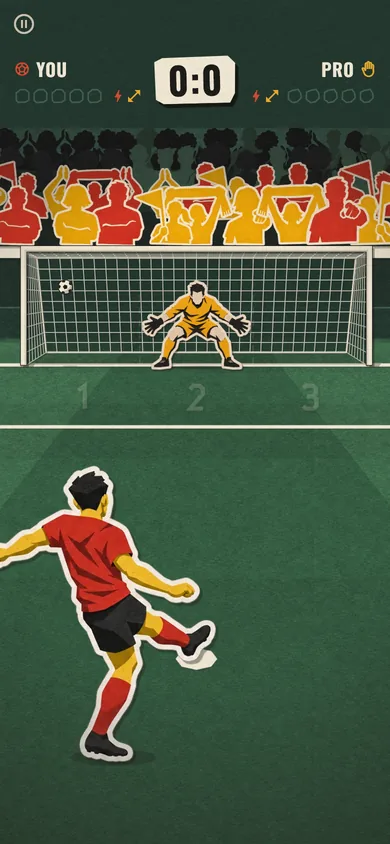
Penalty Bluff keeps the guessing and removes everything else: no reflexes, no weak foot, no shots that fly wide, no posts. The goal is split into zones, three in Classic and five in Pro, and the rule is all or nothing: same zone, save; any other zone, goal. Every zone is worth the same, so the only mix nobody can exploit is the even one:
- Classic, 3 zones: each zone a third of the time. On average the keeper saves one kick in three and the shooter scores two.
- Pro, 5 zones: each zone a fifth of the time. On average the keeper saves one kick in five.
Any lean away from even hands your rival a target. If a shooter never uses the middle, the keeper can ignore it too, split the dives between left and right, and save one kick in two instead of one in three. That is how action bias would cost you here. The middle is just a zone, and a good reader notices if you shy away from it.
The even mix guarantees you the equilibrium result whatever your opponent tries, and nothing more. A keeper diving at random saves one in three against a genius, and one in three against someone who always shoots left. Randomness protects you but never punishes anyone.
The optional tricks change the maths for one kick each: a long reach covers two neighbouring zones and a power shot beats it. When to spend them is covered in the tricks guide.
The computer obeys the same maths. It locks in its pick at the start of each kick and never sees yours, so against a truly random player in Classic it saves one kick in three on average, however clever it is.
Equilibrium is the floor, not the plan
If both players mixed perfectly, every match would be pure chance. Real people don't. Even professionals carry biases, like the empty middle and the urge to dive, and the rest of us carry more (see why you can't be random). In Penalty Bluff you win by leaving the even mix on purpose, to punish a rival who has left it by accident.
The catch is that once you lean, you can be read too. Say you are the keeper and your rival has shot left five times, middle twice and right three times, roughly 50 / 20 / 30.
| Your dives (L / M / R) | Saves if they keep it up | Saves if they turn it round |
|---|---|---|
| Even: 33 / 33 / 33 | 33% | 33% |
| Lean: 50 / 25 / 25 | 37.5% | 25% at worst |
| Lock: always left | 50% | 0% at worst |
Locking on gains the most and risks the most. Leaning keeps part of the gain and gives less away. So:
- Start near even. Early on you know little, and an even mix gives nothing away.
- Look for one clear lean, not a clever theory: a favourite corner, an empty middle, a repeat after every goal.
- Lean, don't lock. Tilt your odds towards the read and keep some surprise.
- Expect the switch. People adapt, and so do the stronger computer opponents. When a read stops working, go back to even until you spot the next one.
One more difference from the real thing. A professional's penalties are usually days or weeks apart, which the 2002 study suggests may be one reason they look so independent. In Penalty Bluff you face the same rival five times in a couple of minutes. That makes reading possible, and being read expensive.
Sources
- Bar-Eli, M., Azar, O. H., Ritov, I., Keidar-Levin, Y. & Schein, G. (2007). Action bias among elite soccer goalkeepers: the case of penalty kicks. Journal of Economic Psychology, 28(5), 606–621.
- Chiappori, P.-A., Levitt, S. & Groseclose, T. (2002). Testing mixed-strategy equilibria when players are heterogeneous: the case of penalty kicks in soccer. American Economic Review, 92(4), 1138–1151.
- Palacios-Huerta, I. (2003). Professionals play minimax. Review of Economic Studies, 70(2), 395–415.
- von Neumann, J. (1928). Zur Theorie der Gesellschaftsspiele. Mathematische Annalen, 100, 295–320.
The maths is half of it. The other half is noticing where your own picks drift away from it.