When to use the power shot and the long reach
Each trick works once per match, and your rival can see whether you still have it, so timing becomes a second guessing game. Here is what an exact analysis of perfect play says.
The rules that matter
With tricks on, each keeper has one long reach per match: a dive that covers two neighbouring zones. Each shooter has one power shot, which beats a long reach. Against a normal dive into its zone, a power shot is saved like any shot (full rules). Two things follow:
- A power shot is never worse than a normal shot. It changes a kick only when it meets a long reach.
- A long reach is never worse than a normal dive, unless it meets a power shot.
What we measured
We solved a whole Classic match exactly (three zones, a shootout of five, sudden death) with both players choosing zone and trick perfectly at every kick. In a guessing game, perfect play means mixing your choices in exactly the right proportions, so your rival gains nothing by changing theirs.
| Perfect play | Long reach | Power shot |
|---|---|---|
| Win chance it adds for its holder | +4.8 points | +3.7 points |
| Uses per player per match | 0.70 | 0.52 |
| When used: helps | 54% | 14% |
| When used: makes no difference | 36% | 86% |
| When used: backfires | 10% | never |
Take away your long reach and an even match drops to about 45% for you; that gap is its value. The long reach earns its value on the kick itself; the power shot mostly by staying in your pocket.
The long reach: a better dive with one risk
A normal dive covers one zone of three; a long reach covers two. In our analysis of perfect play, 54% of long reaches catch the ball in one of their two zones: a save that a normal dive into just one of them could have missed. Another 36% are beaten by a shot into the third zone, which a dive into either covered zone would have missed too.
The last 10% are the risk: the stretch meets a power shot inside its two zones, and a ball that a normal dive into the right zone would have stopped goes in. That is the only way a long reach can hurt you, so the keeper's whole timing question is: does the shooter still have power, and how likely is it now?
Classic tip: with three zones, every long reach spans zones 1–2 or 2–3, so it always covers the centre. When the keeper still has a reach and the shooter has no power left, perfect shooters go down the middle only about one kick in eight by the fifth round, against one in three normally.
The power shot: mostly a threat
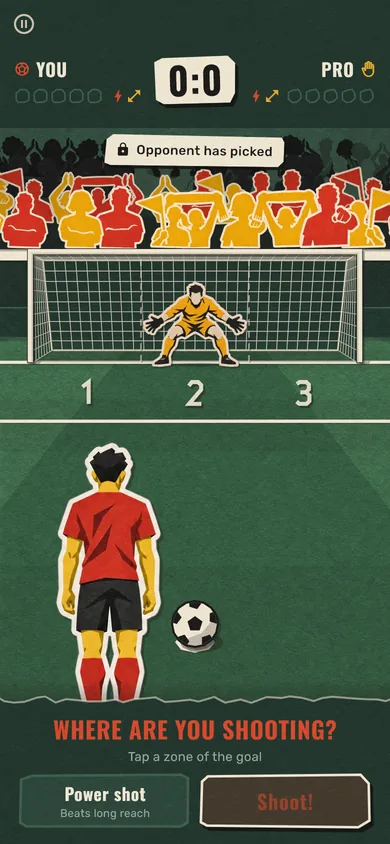
A power shot changes a kick only when the keeper stretches and the ball goes into one of the zones it covers. In perfect play that happens to about one power shot in seven. The other six play out exactly as a normal shot would.
Its real job is to make keepers hesitate: while you hold it, every stretch risks running into it. Compare two positions from our analysis, with the keeper's reach still unused:
- Shooter still holds power: the keeper stretches on about one kick in seven (14–16%) and saves about 35% of shots.
- Shooter has used power: the keeper stretches on roughly every second kick (about 48%) and saves about 50%.
And once the keeper's reach is gone, your power shot can no longer change any kick.
The last-chance rule
Since a power shot is never worse than a normal one, the only reason not to fire it is to keep it for later. On a shooter's last chance there is no later, so power costs nothing there and a keeper should expect it.
So, as keeper: don't stretch on the shooter's last chance while they still have power. The kick before is a good moment, especially against a shooter who is clearly saving their power for the end. In our analysis, facing a live power shot, a perfect keeper stretches on about 14–16% of kicks in rounds one to four, but only 5–11% on the fifth. The shooter's use of power climbs from about 15% on the first kick to 28% on the fifth and in sudden death.
Worked example: 3–3, his fifth kick
You are in goal. You have taken all five kicks, it is 3–3, and if your rival scores now, he wins. He still has power. This is exactly when the power shot is likeliest, and a stretch that meets it hands him the match. In our analysis a perfect keeper stretches here only about one time in twenty. Dive normally: guess right and it is sudden death, with your reach still alive.
Same score, but he used his power earlier? Now a stretch cannot backfire, and a perfect keeper stretches more than half the time (55%).
No power on the other side? Stretch
Once the shooter's power is gone, a long reach covers everything a normal dive into either zone would, and more. It is a free upgrade, and the only mistake left is finishing the match with it unused. Perfect keepers stretch on roughly every second kick from then on.
Don't hoard tricks for the end
It feels natural to save both tricks for the decisive kicks. Perfect play doesn't. In our analysis, tricks are used across all rounds: a player uses power in the first round in 15% of matches and the long reach in 14%, and use falls towards the fifth round rather than building up to it. A trick saved for an obvious moment is a trick your rival is waiting for.
Mixing well means a trick is a small chance on any kick, never a fixed plan. For how to mix, see why you can't be random.
How the computer times its tricks
The computer opponents decide only from what you can see too, the score and the tricks each side has left, and add randomness so their timing can't be read.
- They never use power once your reach is gone, and on their own last chance they always use it if your reach is still there.
- Facing your power on your last chance, they stretch only as a rare bluff, about one time in ten. The kick before is when they are likeliest to stretch.
- If you have no power left, they make sure to use their reach before the kicks run out.
- The Rookie spends tricks at random moments, and if its reach is still unused on your last kick, it stretches whatever you hold. Keep your power for that kick.
In Pro (five zones) both tricks are worth less: +3.8 points for the reach and +2.1 for power, which pays off only about one time in twelve.
Timing is half of the trick game. The other half is still reading where your rival goes.