How to read your rival
Nobody picks at random, even when they try. Here are six habits that turn up again and again, how to spot them inside one match, and how to use them without becoming predictable yourself.
A shootout of five gives you five shots and five dives to study: too little to decode anything complicated, and you don't need to. The habits worth hunting are simple: repeating, switching, avoiding. Studies of rock-paper-scissors, a close cousin of this game, find that people's choices are full of patterns, yet players rarely use the patterns of the person opposite. In the words of Erik Brockbank and Edward Vul (2021), people "cannot exploit these dependencies in their opponents". That gap is your edge.
Keep a tiny scorebook
For each kick, remember three things: where your rival went, whether it worked, and whether it repeated their last pick in that role. Left and right always mean the screen's left and right, the view from behind the ball, in both roles. Mutter it if it helps: "left, scored; left again, saved".
Six habits to look for
1. Going back to what worked
A shooter who scores on the left often goes left again; a keeper who saves by diving right often dives right again. In a lab study of several hundred students playing rock-paper-scissors, the most common response to a win was to repeat the same choice. Spot it: after a goal or a save, does the next pick in that role repeat it? One repeat is a hint, two is a habit.
2. Running from the last failure
The flip side: a shooter who was just saved moves away from that zone, and a keeper who just conceded dives somewhere new. In the same study, the most common response to a loss was a switch. Spot it: watch the pick right after a failure. Then try the counter-intuitive move: if the keeper dived right and you scored left, shoot right next time, because he is likely to run from the side where he failed.
3. Alternating
Left, right, left, right. Alternating feels random to the person doing it, because it never repeats, and it is the easiest habit of all to read. In Classic, alternators often skip the middle entirely. Spot it: three picks that swing from side to side. Good players break the rhythm once it costs them.
4. A favourite side when it matters
Early on, people experiment. On a match point or in sudden death, many fall back on whatever feels safest, usually one particular side, and their very first kick is often a clue to it. Watch for the forgotten middle too, because standing still feels worse than diving the wrong way. A study of 286 professional penalties found that keepers nearly always dived to one side, even though the data showed that staying in the centre was the better choice. Spot it: note the side of their first kick and of every big kick, and count their middles.
5. Copying you
Some players take their cue from you. They shoot where you just shot, dive where you just dived, or shoot at the zone you last dived to. Spot it: compare their pick with your previous pick, not theirs. Most people miss this habit because they only ever watch the rival.
6. "I did that last time, so not again"
Having gone left twice, people feel a third left would be obvious, so they switch; some won't repeat even once. It is a relative of the gambler's fallacy, the feeling that a run must end. Professionals do it too. In a study of 361 kicks from 37 shootouts at major international tournaments, keepers became more likely to dive the other way after several kicks in a row had gone the same way, and the kickers did not take advantage. Spot it: count their repeats. A rival who never repeats has two zones left in Classic, not three, and your chance of a save rises from one in three to one in two.
How to use each habit
| Habit | When you're in goal | When you're shooting |
|---|---|---|
| Going back to what worked | Dive where their last goal went | Avoid the zone of their last save |
| Running from failure | Avoid the zone where you saved them | Shoot where the keeper dived and conceded |
| Alternating | Dive to the side they didn't just use | Shoot to the side the keeper just used |
| Favourite side | Lean to their comfort side on big kicks | Shoot away from it on big kicks |
| Copying you | Dive to your own last shot | Avoid your own last dive |
| Never repeating | Rule out their last zone | Shoot where the keeper just dived |
Use a read without becoming readable
A good read can turn into a habit of your own. Always dive where the last goal went, and a sharp rival only has to notice once.
- Wait for the second sighting. One repeat can be chance.
- Lean, don't lock. Use a read on some kicks, not every one.
- Drop it when it fails twice running. They have probably noticed.
- Keep your other role quiet. Plan your own picks in advance; why you can't be random shows how.
- Know when to stop. If nothing fits after four or five kicks, stop hunting. Against a truly unpredictable rival, no keeper can expect more than one save in three in Classic, or one in five in Pro.
Tells: when a glance lies
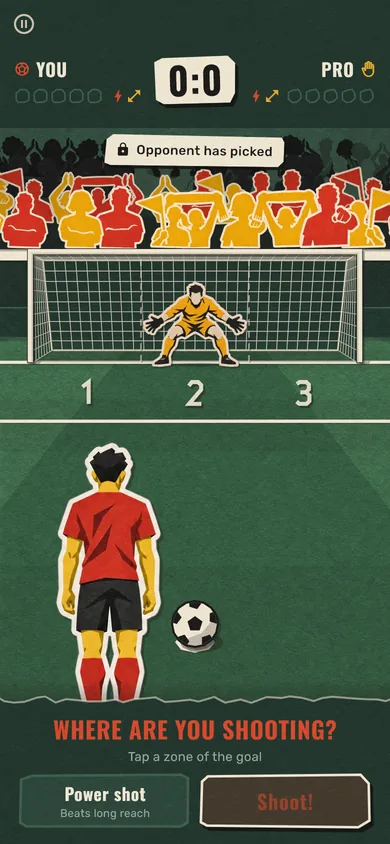
In Career, some computer rivals give themselves away before you pick. When such a rival is shooting, the badge that normally reads "Opponent has picked" can say "Glances to the left" instead. When he is in goal, watch the keeper: he may shift his weight towards one side while he waits. The career screen tells you in advance which rivals do this.
A tell is not a promise. Some rivals glance honestly most of the time, some look one way and go the other, and some mix the two. Treat the first few as an experiment:
- Note each glance and where the rival actually went.
- After three or four, decide: mostly true, mostly false, or no pattern?
- Mostly true: follow it. Mostly false: just as useful, so read it backwards. No pattern: ignore it and watch habits instead.
A tell never means the computer has seen your pick. Its own pick is sealed at the start of the kick, and the glance only hints at what it already chose, or at what it wants you to think it chose.
The computer is reading you too
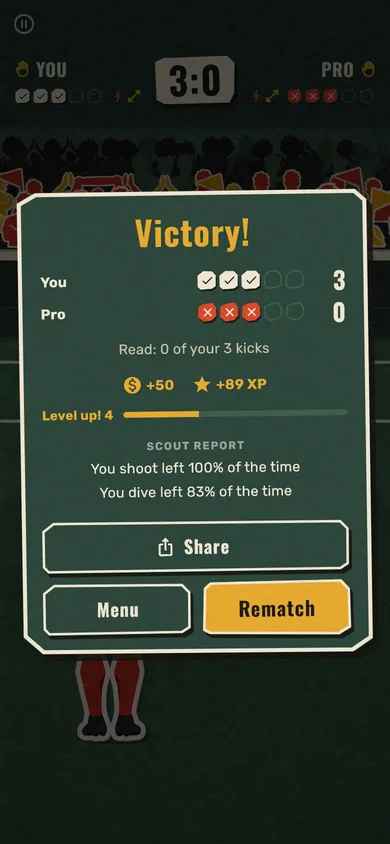
Everything above works in reverse. The computer opponents hunt for these same habits in your picks, using a set of small pattern-spotters and listening most to whichever has been right lately. After a match, the scout report may name your strongest habit, for example "After a goal you shoot the same spot again". If it does, that is the habit to break next.
Sources
- Brockbank, E. & Vul, E. (2021). Formalizing opponent modeling with the rock, paper, scissors game. Games, 12(3), 70.
- Wang, Z., Xu, B. & Zhou, H.-J. (2014). Social cycling and conditional responses in the Rock-Paper-Scissors game. Scientific Reports, 4, 5830.
- Bar-Eli, M., Azar, O. H., Ritov, I., Keidar-Levin, Y. & Schein, G. (2007). Action bias among elite soccer goalkeepers: The case of penalty kicks. Journal of Economic Psychology, 28(5), 606–621.
- Misirlisoy, E. & Haggard, P. (2014). Asymmetric predictability and cognitive competition in football penalty shootouts. Current Biology, 24(16), 1918–1922.
Fourteen career rivals, one habit each. Ready to test your reads?